

Targeted Protein Degradation Market is expected to Hit US$ 4.53 Billion by 2033 | DataM Intelligence
Targeted Protein Degradation Market
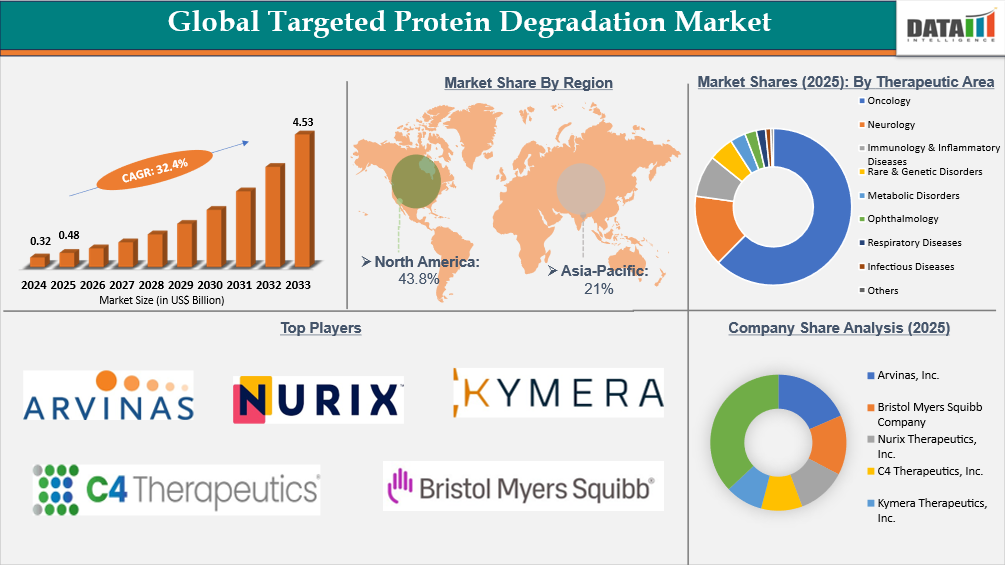
The Global Targeted Protein Degradation Market is expected to reach at a CAGR of 32.4% from 2026 to 2033.
The Targeted Protein Degradation Market set to revolutionize therapies, with rapid growth, cutting-edge technologies, and rising adoption across oncology and rare diseases.”
AUSTIN, TX, UNITED STATES, February 23, 2026 /EINPresswire.com/ -- Market Overview:— DataM Intelligence
The Global Targeted Protein Degradation Market is witnessing unprecedented growth, driven by advancements in biopharmaceutical research and the increasing demand for novel therapeutic approaches. Targeted protein degradation (TPD) represents a paradigm shift in drug discovery, enabling the selective elimination of disease-causing proteins rather than merely inhibiting them. This innovative approach has shown immense potential in treating a wide array of diseases, including oncology, neurodegenerative disorders, and autoimmune conditions. The market is characterized by a robust pipeline of degraders, including PROTACs (Proteolysis Targeting Chimeras) and molecular glues, which are gaining attention from both pharmaceutical companies and research institutions worldwide.
To Download Sample Report Here: https://www.datamintelligence.com/download-sample/targeted-protein-degradation-market
According to DataM Intelligence, The Global Targeted Protein Degradation Market was valued at approximately USD 0.48 billion in 2025 and is projected to grow at a CAGR of 32.4% from 2026 to 2033. North America currently holds the leading market share, primarily due to the presence of well-established biotechnology firms, extensive research infrastructure, and high adoption rates of advanced therapies. Among product types, PROTACs dominate the market, accounting for over 55% of the revenue share, owing to their high specificity and ability to target previously “undruggable” proteins. Key drivers propelling market growth include rising R&D investments, favorable regulatory frameworks for innovative therapies, and growing collaborations between biotech companies and academic institutions.
Key Highlights from the Report:
The Global Targeted Protein Degradation Market is projected to surpass USD 4.53 billion by 2033.
PROTACs remain the most lucrative product segment in the market.
Oncology applications account for the largest share of therapeutic end-uses.
North America leads the market due to strong research and development activities.
Partnerships between biotech firms and academia are accelerating innovation in TPD.
Molecular glues are emerging as a promising segment with high growth potential.
Market Segmentation:
The Targeted Protein Degradation Market can be segmented based on product type, end-user, and therapeutic application. By product type, the market is primarily divided into PROTACs and molecular glues. PROTACs are favored for their ability to degrade specific proteins with high efficiency, while molecular glues are gaining traction for their simpler design and potential in targeting difficult-to-drug proteins. By therapeutic application, oncology dominates the market due to the high prevalence of cancer and the critical need for precision therapies. Other applications include neurology, immunology, and rare diseases, where targeted degradation therapies are showing promising early-stage results. End-user segmentation includes pharmaceutical and biotechnology companies, research institutes, and hospitals, with pharmaceutical companies contributing the largest revenue share due to their focus on commercializing novel protein degraders.
Speak to Our Analyst and Get Customization in the report as per your requirements: https://www.datamintelligence.com/customize/targeted-protein-degradation-market
Regional Insights:
Regionally, the North American market is at the forefront, driven by the United States, which hosts a dense network of biotech hubs and innovation centers. Europe follows closely, supported by strong research initiatives in countries like Germany, Switzerland, and the United Kingdom, along with collaborative partnerships between public and private institutions. The Asia-Pacific region is emerging as a high-growth market due to increasing R&D investments, improving healthcare infrastructure, and supportive government initiatives in countries like China, Japan, and India. Meanwhile, Latin America and the Middle East & Africa are expected to witness steady growth, mainly due to rising awareness of targeted therapies and the gradual adoption of advanced biopharmaceutical technologies.
Market Dynamics:
Market Drivers:
The primary drivers of the targeted protein degradation market include technological advancements in drug design, an expanding pipeline of PROTACs and molecular glues, and a growing focus on precision medicine. The rising incidence of cancer and chronic diseases has amplified the demand for therapies that can effectively target disease-causing proteins. Additionally, increasing collaborations between pharmaceutical companies and academic research centers are accelerating the development and commercialization of novel TPD-based therapies.
Market Restraints:
Despite promising growth, the market faces several challenges. High development costs, complex regulatory approval processes, and limited long-term clinical data on safety and efficacy are major restraints. Furthermore, intellectual property disputes and the technical complexity of designing selective protein degraders could slow down market expansion.
Market Opportunities:
The market presents substantial opportunities for growth, particularly in emerging regions and for underexplored therapeutic areas such as neurodegenerative diseases and autoimmune disorders. Investments in next-generation degraders, advancements in drug delivery mechanisms, and the integration of AI in drug discovery offer potential for higher efficiency and reduced development timelines. The rising trend of strategic partnerships, licensing agreements, and mergers & acquisitions further enhances the market’s growth prospects.
Looking For Full Report? Get it Here: https://www.datamintelligence.com/buy-now-page?report=targeted-protein-degradation-market
Frequently Asked Questions (FAQs):
How Big is the Targeted Protein Degradation Market in 2026?
What is the Projected Growth Rate of the Global TPD Market from 2026 to 2033?
Which Therapeutic Applications Dominate the Targeted Protein Degradation Market?
Who are the Key Players in the Global Targeted Protein Degradation Market?
Which Region is Estimated to Lead the Market during the Forecast Period?
Company Insights:
Key players operating in the Targeted Protein Degradation Market include:
Arvinas, Inc.
Bristol Myers Squibb Company
Kymera Therapeutics, Inc.
Nurix Therapeutics, Inc.
C4 Therapeutics, Inc.
Pfizer Inc.
Novartis AG
Foghorn Therapeutics, Inc.
Vividion Therapeutics, Inc.
AbbVie Inc.
Amgen Inc.
Genentech, Inc.
Sanofi S.A.
Cullgen Inc.
Monte Rosa Therapeutics, Inc.
Zymeworks Inc.
BeiGene, Ltd.
Recent Developments:
United States:
January 2026: AI-driven drug discovery gained momentum with integrations accelerating TPD pipelines, including ligand discovery and protein-ligase matching to shorten R&D timelines.
January 2026: EpiBiologics raised $107 million in Series B funding, backed by Google and Johnson & Johnson, to advance EPI-326, an EGFR degrader for non-small cell lung cancer and head and neck cancers into clinical trials.
December 2025: Increased venture capital investments poured into TPD startups, supporting accelerated drug discovery and clinical development amid rising interest in novel therapies.
November 2025: Kymera Therapeutics presented preclinical data on STAT6 degraders at the Jefferies Conference, showing potential superiority to existing biologics like Dupixent for inflammatory diseases by achieving over 90% degradation.
Japan:
January 2026: Conferences like the International Conference on Biotechnology and Bioengineering in Tokyo highlighted TPD research, fostering academic-industry collaborations in protein degradation technologies.
December 2025: Ongoing growth in Japan's TPD ecosystem was supported by a thriving venture capital scene and rising acceptance of personalized medicine, boosting demand for innovative degraders.
November 2025: FIMECS expanded its joint research agreement with Astellas Pharma by adding two new TPD targets, receiving a JPY 400 million upfront payment to advance the collaboration started in 2022.
Unlock 360° Market Intelligence with DataM Subscription Services: https://www.datamintelligence.com/reports-subscription
Conclusion:
The Targeted Protein Degradation Market represents a transformative frontier in drug discovery and precision medicine. With significant investments in R&D, strong collaborations, and technological advancements, the market is poised for sustained growth. PROTACs and molecular glues are reshaping the therapeutic landscape, particularly in oncology and neurodegenerative disorders, while emerging regions offer untapped potential for expansion. As the market matures, innovations in protein degrader design and delivery will continue to drive adoption, positioning targeted protein degradation as a cornerstone of next-generation therapeutics.
Related Reports:
Targeted Therapy Market
Aromatase Inhibitor Drug Class Market
Sai Kiran
DataM Intelligence 4Market Research
+1 877-441-4866
Sai.k@datamintelligence.com
Visit us on social media:
LinkedIn
X
Legal Disclaimer:
EIN Presswire provides this news content "as is" without warranty of any kind. We do not accept any responsibility or liability for the accuracy, content, images, videos, licenses, completeness, legality, or reliability of the information contained in this article. If you have any complaints or copyright issues related to this article, kindly contact the author above.
