

Rainwater Harvesting Market Size to Hit USD 1,658.81 Million by 2032 at 5.2% CAGR | Industry Growth Outlook Report
Rainwater Harvesting Market graph
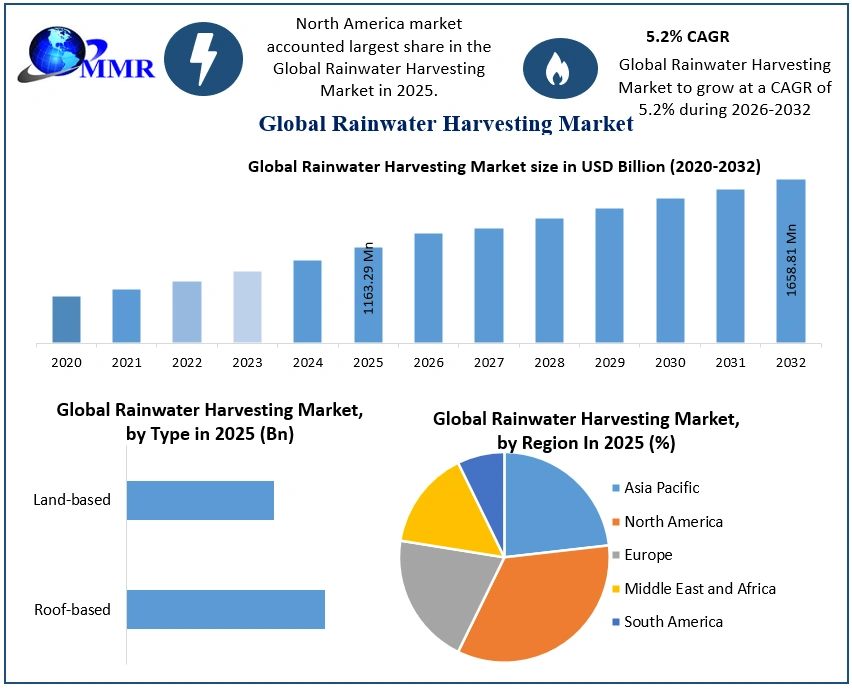
Rainwater Harvesting Market was USD 1,163.29 Million in 2025, growing at 5.2% CAGR to reach nearly USD 1,658.81 Million by 2032.
Developers now design storage capacity before floor plans, proving water security planning is reshaping construction economics across regions worldwide”
NEW YORK, NY, UNITED STATES, February 23, 2026 /EINPresswire.com/ -- Rainwater Harvesting Market size was valued at USD 1163.29 Million in 2025 and the total Rainwater Harvesting revenue is expected to grow at a CAGR of 5.2% from 2025 to 2032, reaching nearly USD 1658.81 Million by 2032.— Maximize Market Research
The sector is evolving into compliance-driven infrastructure as regulations and tariffs reshape adoption economics. The municipal water infrastructure planning increasingly links approvals with storage capacity, while future expansion reflects impact of water scarcity on rainwater harvesting demand, positioning systems as operational water security assets rather than sustainability upgrades.
Get Full PDF Sample Copy of Report: (Including Full TOC, List of Tables & Figures, Chart) @ https://www.maximizemarketresearch.com/request-sample/12432/
Rainwater Harvesting Market Growth Accelerates as Regulatory Mandates Replace Voluntary Adoption
Regulatory tightening is no longer symbolic — it is procedural. In markets such as Singapore, explicit submission requirements, including metering disclosures and technical annexures, are transforming pilot installations into mandated infrastructure. This shift is materially accelerating the rainwater harvesting market adoption curve. Simultaneously, cities reviving groundwater management programs are imposing retrofit timelines, moving investment decisions from discretionary sustainability budgets to structured capital expenditure cycles, strengthening long-term visibility within the urban water management solutions market.
Rainwater Harvesting Market Expansion Slows Amid Capital Intensity and Fragmented Compliance Standards
Despite policy momentum, capital intensity remains a practical barrier. Higher upfront tank integration costs and fragmented building-code harmonization across regions create execution friction. Divergent municipal inspection standards — particularly across large federal markets — delay project approvals and complicate pipeline conversion, moderating near-term rainwater harvesting market growth even where demand fundamentals remain strong.
Rainwater Harvesting Market Opportunities Emerge Through IoT Monitoring and Lifecycle Service Models
The integration of IoT-enabled predictive monitoring is redefining value capture within the water conservation systems market. Advanced analytics now forecast storage turnover and water quality thresholds, enabling operators to offer filtration-as-a-service models and performance-linked maintenance contracts. This evolution allows institutional investors to quantify lifecycle returns on decentralized storage assets, amplifying the measurable impact of water scarcity on rainwater harvesting demand.
Rainwater Harvesting Market Forecast Impacted by Supply Chain Concentration and Manufacturing Delays
Supply-chain concentration in polymer and steel storage manufacturing continues to influence delivery timelines, particularly in emerging regions responding to drought-driven procurement surges. Delays in local capacity expansion extend project lead times, introducing variability into the rainwater harvesting market forecast and rewarding suppliers with regionalized production footprints and digital distribution networks.
Rainwater Harvesting Market Trends Shift from Installation Volume to Compliance-Driven Infrastructure Strategy
Commercial customers increasingly treat harvested water as a utility hedge rather than a sustainability gesture. Within the rainwater harvesting market trends, corporate resilience frameworks now incorporate storage systems alongside energy risk models. Vendors that integrate engineering, monitoring, and compliance documentation are gaining preference, signaling that competitive advantage is shifting from standalone components to compliance-enabled infrastructure ecosystems.
Rainwater Harvesting Market Segmentation by Type, Product and End-User with Regulatory Adoption Insights
Segmentation Structure: The Rainwater Harvesting Market is segmented by type, product, and end-user, reflecting infrastructure deployment patterns rather than standalone product preference.
By Type:
Roof-based systems dominate the rainwater collection system market due to predictable runoff quality and easier integration.
Land-based installations support groundwater recharge and large-scale water retention planning.
By Product:
Tanks provide primary storage buffering capacity.
Accessories ensure filtration and compliance performance.
Services manage inspection, maintenance, and lifecycle efficiency.
By End-User:
Residential adoption focuses on tariff optimization.
Commercial installations enhance building certification value.
Industrial users stabilize process water continuity.
Agriculture supports irrigation reliability and seasonal storage needs.
Adoption Pattern: Deployment increasingly aligns with global rainwater harvesting market segmentation by end-user, influenced by regulatory water reuse mandates.
By Type
Roof-based
Land-based
By Product
Tanks
Accessories
Service
By End-User
Residential
Commercial
Industrial
Agriculture
Get Full PDF Sample Copy of Report: (Including Full TOC, List of Tables & Figures, Chart) @ https://www.maximizemarketresearch.com/request-sample/12432/
Rainwater Harvesting Market Key Developments Highlight Partnerships, Smart Systems and Supply Expansion
On 18 March 2025, Kingspan Group launched modular smart storage platforms integrating monitoring controls, supporting adoption momentum by improving maintenance predictability and improving long-term sector visibility across commercial infrastructure adoption.
On 27 July 2024, Watts Water Technologies deployed integrated filtration assemblies within the water conservation systems market, improving operational efficiency and reinforcing standardization toward compliance-driven installations in institutional buildings.
On 11 November 2024, Graf Group partnered with municipal planners within the urban water management solutions market, accelerating adoption and improving planning predictability through city-scale decentralized infrastructure planning frameworks.
On 6 February 2025, Rotoplas expanded manufacturing capabilities for storage modules across emerging regions, strengthening the global rainwater harvesting market outlook by improving supply reliability and supporting capacity expansion in water-scarcity driven projects.
Global Rainwater Harvesting Market Regional Adoption Driven by Policy Compliance and Cost Optimization
Asia-Pacific
Asia-Pacific leads the segment as building codes embed decentralized storage into approvals. The urban water management solutions market expands through municipal audits linking water permits to rooftop retention performance compliance records.
Europe
Europe’s deployment pace aligns with flood mitigation policy. The sustainable water infrastructure market integrates retention capacity into drainage planning, where insurers increasingly assess property resilience using certified water reuse installations.
North America
North America shows rising participation in the decentralized water systems industry through operational cost modelling. The commercial rainwater harvesting market grows as facility managers treat captured water as utility risk management rather than environmental compliance expenditure.
Rainwater Harvesting Market Competitive Landscape
The industry remains capability-driven, where Kingspan Group, Graf Group, and CST Industries focus on storage infrastructure while WISY AG and Watts Water Technologies influence filtration standards within the water conservation systems market. Regional players including Netsol Water Solutions and Rotoplas compete through regulatory integration and lifecycle service reliability differentiation.
Rainwater Harvesting Market, Key Players
Watts Water Technologies
Brae Water
Rainwater Management Solutions
CST Industries
Brac Systems
Aquascape
Rain Harvesting Pty Ltd
The RainCatcher
Graf Group
WISY AG
Kingspan Group
Stormsaver
Mall GmbH
Polypipe
Hauraton
Alumasc Water Management Solutions
Nippon Steel Kowa Unite Co., Ltd.
Wah Sang Water Technology
D&D Ecotech Services
Water Field Technologies
BLUE TAP
Netsol Water Solutions
Clean Water Asia
Rain Harvesting Pty Ltd
Rotoplas
Water Harvesting Solutions
Epic Middle East
Get access to the full description of the report @ https://www.maximizemarketresearch.com/market-report/rainwater-harvesting-market/12432/
FAQ’s
What is the market estimation of the rainwater harvesting market?
Ans: The rainwater harvesting market size was valued at USD 1163.29 million in 2025 and is projected to reach nearly USD 1658.81 million by 2032, indicating stable long-term expansion.
What factors are driving rainwater harvesting market growth?
Ans: Adoption is supported by urban water scarcity regulations, infrastructure compliance requirements, and rising utility tariffs, encouraging integration of decentralized storage within the water conservation systems market across commercial and municipal facilities.
Which sectors are increasing adoption in the rainwater harvesting market?
Ans: The sector is witnessing higher participation from residential housing, industrial facilities, and agriculture irrigation users, where supply reliability and cost predictability are influencing infrastructure decisions within the urban water management solutions market.
Which regions dominate the rainwater harvesting market outlook?
Ans: Regional adoption is led by Asia-Pacific through regulatory mandates, followed by Europe’s flood resilience policies and North America’s cost management adoption within the commercial rainwater harvesting market.
Analyst Perspective
From an analyst standpoint, the storage deployment ecosystem is transitioning from environmental initiative to regulated infrastructure layer. Regulatory water management systems increasingly influence permitting decisions, while the commercial rainwater harvesting market reframes installations as operating-cost stabilization tools. Technology integration indicates systems are becoming operational assets rather than backup utilities. Regulatory convergence across regions suggests adoption cycles will follow building compliance timelines instead of voluntary sustainability programs. Notably, investment patterns align with impact of water scarcity on rainwater harvesting demand, implying future growth will depend more on policy enforcement consistency than equipment innovation speed.
Related Reports
Crop Harvesting Robots Market: https://www.maximizemarketresearch.com/market-report/global-crop-harvesting-robots-market/148199/
Harvesting Machinery Market: https://www.maximizemarketresearch.com/market-report/global-harvesting-machinery-market/95553/
Automotive Energy Harvesting and Regeneration Market: https://www.maximizemarketresearch.com/market-report/global-automotive-energy-harvesting-and-regeneration-market/35860/
Precision Harvesting Market: https://www.maximizemarketresearch.com/market-report/global-precision-harvesting-market/34427/
Top Reports:
Global Dispatch Console Market size is expected to reach nearly US $ 2.47 Bn by 2029 with the CAGR of 4.6% during the forecast period. https://www.maximizemarketresearch.com/market-report/global-dispatch-console-market/54914/
Global Lab Automation in Analytical Chemistry Market size was valued at USD 5.10 Bn. in 2024 and the total Lab Automation in Analytical Chemistry Market revenue is expected to grow by 4.28% from 2025 to 2032, reaching nearly USD 7.13 Bn, growth is driven by rising demand for high-throughput analysis and improved laboratory efficiency. https://www.maximizemarketresearch.com/market-report/global-lab-automation-in-analytical-chemistry-market/22186/
Power Distribution Unit Market was valued at USD 4.56 Bn. In 2024 and the total revenue of Global Power Distribution Unit Market is expected to grow at a CAGR of 7.46% from 2025 to 2032 reaching nearly 8.11 Bn. by 2032. https://www.maximizemarketresearch.com/market-report/global-power-distribution-unit-market/21805/
The Electronic Access Control Systems Market size was valued at USD 46.08 Billion in 2024 and the total Electronic Access Control Systems revenue is expected to grow at a CAGR of 11.21% from 2025 to 2032, reaching nearly USD 107.82 Billion. https://www.maximizemarketresearch.com/market-report/global-electronic-access-control-systems-market/23261/
The Urea Market size was valued at USD 46.75 Billion in 2025 and the total Urea revenue is expected to grow at a CAGR of 2.8% from 2026 to 2032, reaching nearly USD 56.72 Billion by 2032. https://www.maximizemarketresearch.com/market-report/global-urea-market/26788/
About Maximize Market Research
Maximize Market Research is a global market research and business consulting firm delivering data-driven insights across water reuse infrastructure. Our sector analysis supports strategic decisions by evaluating rainwater harvesting market size structure, adoption drivers, regulatory frameworks, storage integration practices, infrastructure reliability, and competitive positioning across global water management networks.
Domain Focus – Energy & Power
Within the Energy & Power domain, Maximize Market Research provides in-depth intelligence across the rainwater harvesting market, including municipal infrastructure, commercial facilities, industrial water reuse, and decentralized supply systems. Our expertise covers lifecycle performance evaluation, regional deployment distribution, and long-term industry forecast development for institutional stakeholders.
Lumawant Godage
MAXIMIZE MARKET RESEARCH PVT. LTD.
+ +91 96073 65656
email us here
Visit us on social media:
LinkedIn
Instagram
Facebook
X
Legal Disclaimer:
EIN Presswire provides this news content "as is" without warranty of any kind. We do not accept any responsibility or liability for the accuracy, content, images, videos, licenses, completeness, legality, or reliability of the information contained in this article. If you have any complaints or copyright issues related to this article, kindly contact the author above.
