

Global Air Compressor Control System Market Outlook 2026–2036: Efficiency-Driven Growth Accelerates at 5.6% CAGR
Air Compressor Control System Market
Industrial energy optimization and automation drive air compressor control systems past USD 2,138.0 million by 2036.
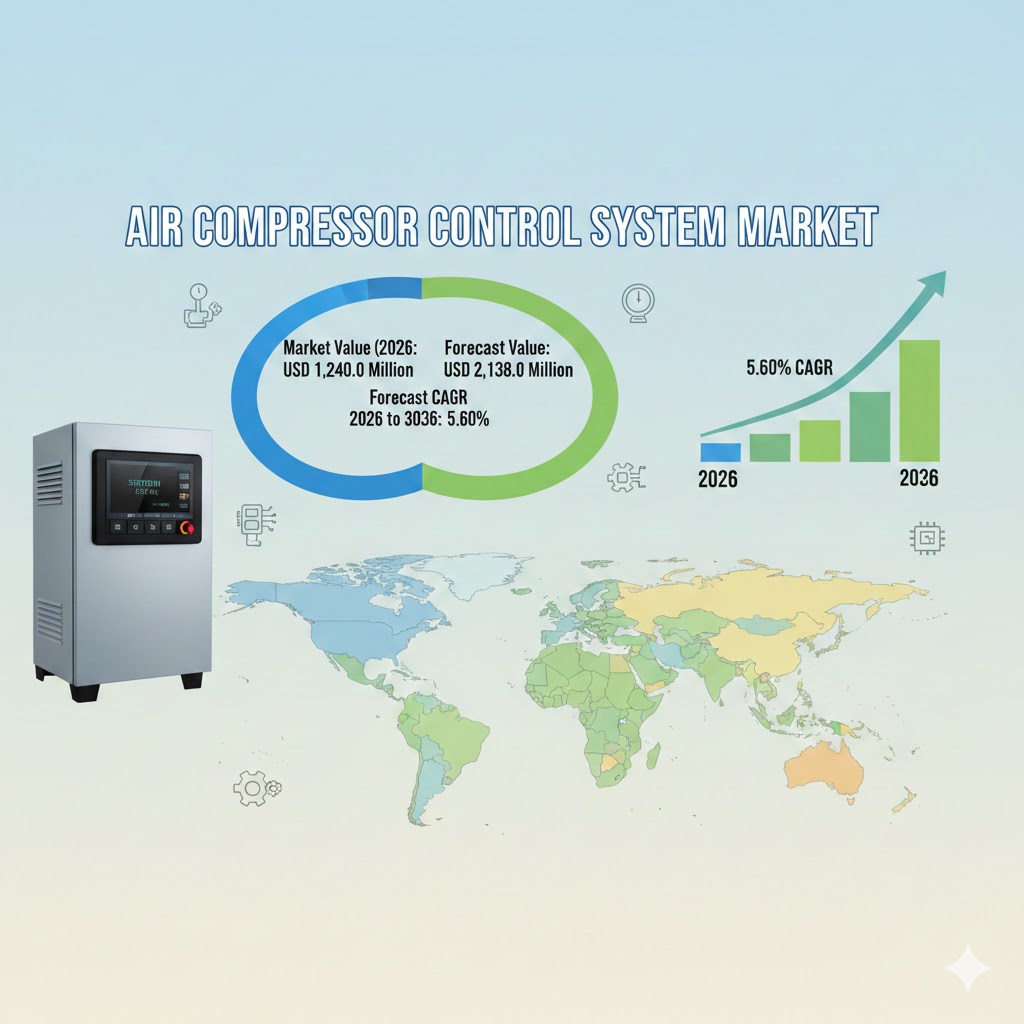
NEWARK, DE, UNITED STATES, February 23, 2026 /EINPresswire.com/ -- The global Air Compressor Control System Market is projected to be valued at USD 1,240.0 million in 2026 and is forecast to reach USD 2,138.0 million by 2036, expanding at a steady CAGR of 5.6%. The market’s trajectory reflects growing industrial automation, higher electricity tariffs, and a strategic push toward energy-efficient compressed air systems across manufacturing economies.
Compressed air accounts for a significant share of total industrial electricity consumption. In many facilities, inefficient sequencing, pressure instability, and idle running inflate operational costs. Advanced control systems address these inefficiencies by enabling real-time load management, multi-compressor coordination, and demand-responsive motor control.
Request For Sample Report | Customize Report | Purchase Full Report–
https://www.futuremarketinsights.com/reports/sample/rep-gb-30972
Market Snapshot: Key Figures
- Market Value (2026): USD 1,240.0 Million
- Forecast Value (2036): USD 2,138.0 Million
- CAGR (2026–2036): 5.6%
- Leading Control Type: Integrated Variable Speed Drive (VSD) Controllers (44% share)
- Leading End Use: Manufacturing (36% demand share)
- High-Growth Regions: Asia Pacific, North America, Europe
- Growth Drivers: Energy Efficiency & Digitalization
Industrial operators are prioritizing compressed air optimization to reduce energy waste and meet sustainability mandates. Control systems regulate load-unload cycles, stabilize pressure levels, and balance runtimes across multiple compressors.
Key Growth Catalysts:
- Rising electricity costs increasing ROI visibility
- Industry 4.0 adoption across manufacturing plants
- Integration with plant-wide energy management systems
- Expansion of predictive maintenance platforms
- Shift toward centralized multi-compressor control architectures
Modern control systems integrate PLCs, sensors, HMIs, and cloud monitoring tools, delivering actionable insights into pressure, temperature, runtime hours, and fault conditions.
Technology Leadership: Why Integrated VSD Controllers Dominate
Integrated VSD controllers hold approximately 44% market share due to their ability to align motor speed precisely with air demand. Unlike traditional load-unload systems, VSD technology eliminates unnecessary energy spikes and minimizes mechanical stress.
Advantages of Integrated VSD Systems:
- Up to significant reductions in energy consumption under variable loads
- Lower heat generation and extended compressor lifespan
- Simplified installation through built-in architecture
- Enhanced reliability and reduced pressure fluctuations
As energy optimization targets become stricter, VSD integration remains the preferred configuration in modern compressed air systems.
Manufacturing: Core Demand Engine
Manufacturing accounts for nearly 36% of total end-use demand. Compressed air supports pneumatic tools, robotics, material handling systems, packaging lines, and automated assembly.
Why Manufacturing Leads:
- Continuous production requiring stable pressure
- Multi-compressor operations demanding coordinated sequencing
- Strong focus on uptime and quality control
- Growing smart factory investments
Advanced control platforms help manufacturers reduce idle runtime, balance compressor loads, and prevent costly downtime.
Regional Outlook: Asia Driving Momentum
Emerging and industrializing economies are accelerating adoption of intelligent compressor control systems.
Country-Level CAGR Highlights:
- India: 6.9% – Driven by automation in automotive, metals, and pharmaceuticals
- Vietnam: 6.6% – Supported by export-led manufacturing growth
- Indonesia: 6.3% – Expansion of cement, food, and processing industries
- China: 5.7% – Retrofit demand in mature industrial facilities
- Malaysia: 5.4% – Gradual modernization and efficiency-focused upgrades
India leads growth as rising electricity costs encourage centralized compressor management and digital monitoring upgrades.
Competitive Landscape: Integration & Algorithm Advantage
Competition centers on energy optimization capability, interoperability, and lifecycle service access.
Leading OEM-driven platforms include solutions from:
- Atlas Copco
- Ingersoll Rand
- Kaeser Kompressoren
- Sullair
Automation-driven competitors offering open-architecture control platforms include:
- Siemens
- Schneider Electric
- Rockwell Automation
- Mitsubishi Electric
- ABB
OEMs differentiate through compressor-native controllers and service contracts, while automation firms compete on PLC/SCADA integration, cybersecurity readiness, and IIoT connectivity.
Market Challenges
Despite steady growth, adoption barriers remain:
- High initial investment for advanced platforms
- Integration complexity across mixed-brand compressor fleets
- Limited technical expertise in parameter optimization
- Cybersecurity concerns in networked control systems
However, increasing ROI awareness and sustainability mandates are gradually mitigating these constraints.
Outlook: Consistent, Efficiency-Driven Expansion
From 2026 to 2036, the air compressor control system market is expected to witness stable, technology-led growth. Industrial facilities are shifting from reactive maintenance to predictive, data-driven compressor management.
Vendors capable of delivering advanced algorithms, open integration capabilities, and scalable digital platforms will capture the largest value share as industrial energy optimization becomes a strategic imperative.
Before finalizing your investment roadmap:
Get data that aligns with your strategic priorities — ask for report customization today:
https://www.futuremarketinsights.com/customization-available/rep-gb-30972
Related Reports:
Japan Compact Construction Equipment Market-
https://www.futuremarketinsights.com/reports/japan-compact-construction-equipment-market
United Kingdom Compact Construction Equipment Market-
https://www.futuremarketinsights.com/reports/united-kingdom-compact-construction-equipment-market
Gulf Countries Compact Construction Equipment Market-
https://www.futuremarketinsights.com/reports/gulf-countries-compact-construction-equipment-market
Have a specific Requirements and Need Assistant on Report Pricing or Limited Budget please contact us - sales@futuremarketinsights.com
About Future Market Insights (FMI)
Future Market Insights, Inc. (FMI) is an ESOMAR-certified, ISO 9001:2015 market research and consulting organization, trusted by Fortune 500 clients and global enterprises. With operations in the U.S., UK, India, and Dubai, FMI provides data-backed insights and strategic intelligence across 30+ industries and 1200 markets worldwide.
Contact Us:
Future Market Insights Inc.
Christiana Corporate, 200 Continental Drive,
Suite 401, Newark, Delaware - 19713, USA
T: +1-347-918-3531
Why FMI: https://www.futuremarketinsights.com/why-fmi
For Sales Enquiries: sales@futuremarketinsights.com
Website: https://www.futuremarketinsights.com
LinkedIn| Twitter| Blogs | YouTube
Sudip Saha
Future Market Insights Inc.
+1 347-918-3531
email us here
Legal Disclaimer:
EIN Presswire provides this news content "as is" without warranty of any kind. We do not accept any responsibility or liability for the accuracy, content, images, videos, licenses, completeness, legality, or reliability of the information contained in this article. If you have any complaints or copyright issues related to this article, kindly contact the author above.
