

Cultivated Fish Collagen Peptides Market Growth 2026–2036: Global Market to Reach USD 879.0 Million by 2036 at 7.8% CAGR
Cultivated Fish Collagen Peptides Market
Cultivated Fish Collagen Peptides Market is driven by rising global demand for bioavailable marine protein in nutraceuticals and beauty-from-within applications
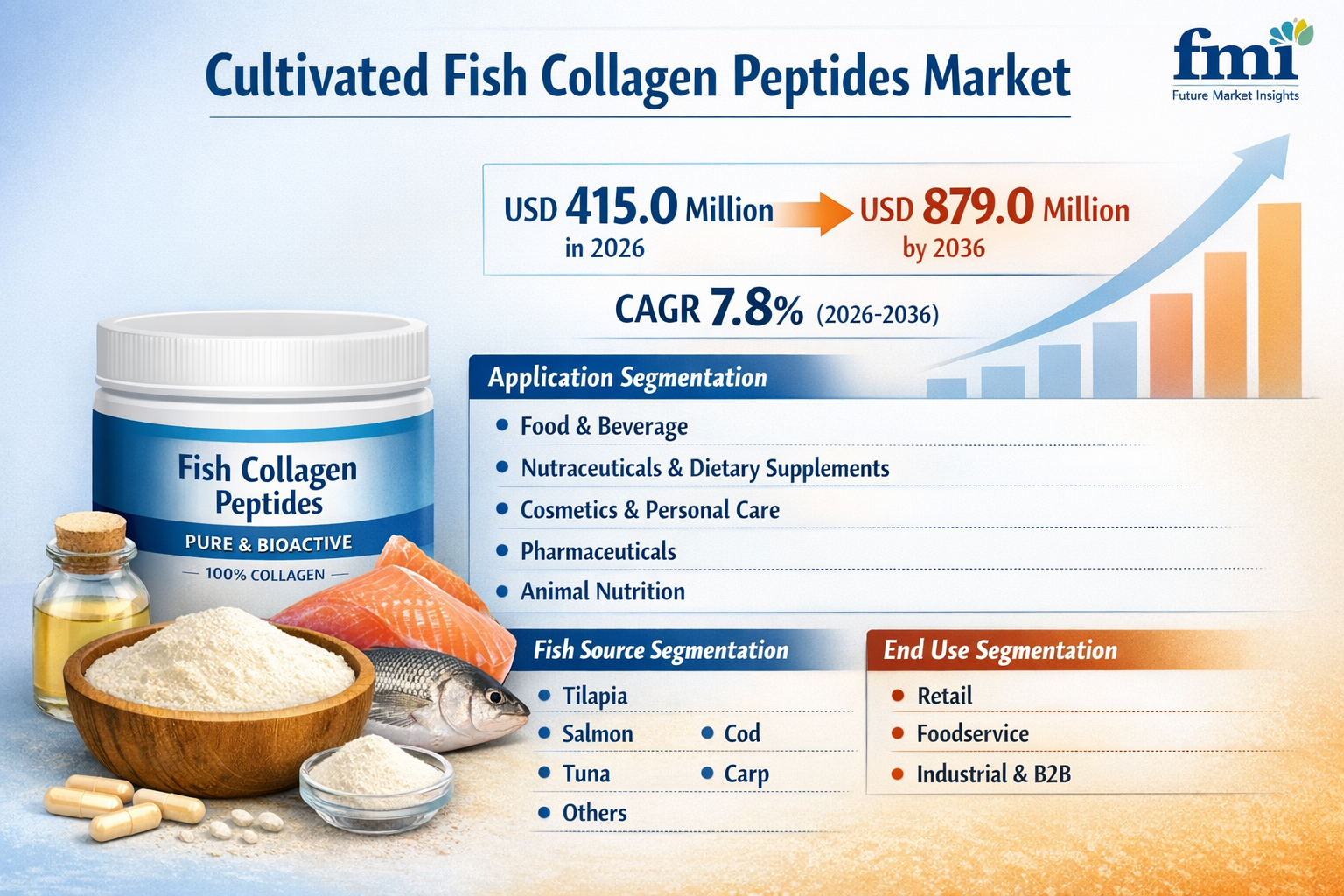
NEWARK, DE, UNITED STATES, February 26, 2026 /EINPresswire.com/ -- The global cultivated fish collagen peptides market is entering a structural growth phase, driven by premium nutraceutical demand, aquaculture by-product optimization, and consumer preference shifts toward marine-derived protein sources. According to the latest analysis by Future Market Insights (FMI), the market was valued at USD 385.0 million in 2025 and is projected to reach USD 415.0 million in 2026. By 2036, revenues are forecast to expand to USD 879.0 million, reflecting a CAGR of 7.8% during 2026–2036.
The market is expected to generate an absolute dollar opportunity of USD 464.0 million over the forecast period, nearly doubling its revenue base. FMI characterizes this trajectory as a compound multiplication cycle supported by application diversification and expanding consumer awareness of collagen’s role in joint health, skin elasticity, and muscle recovery.
Request For Sample Report | Customize Report | Purchase Full Report - https://www.futuremarketinsights.com/reports/sample/rep-gb-32102
Growth remains anchored in rising supplement consumption among adults aged 35+, particularly in North America, Western Europe, and urban East Asia. At the same time, aquaculture expansion in Asia Pacific and Latin America is improving raw material availability by converting fish processing by-products into high-value functional ingredients.
Demand Drivers Reshaping the Market
Several structural shifts are reinforcing market expansion:
• Increasing consumer awareness of collagen’s clinically studied benefits for joint health, skin firmness, and muscle recovery.
• Rising preference for non-bovine, halal-certified, and pescatarian-compatible protein sources across Middle Eastern, Southeast Asian, and Jewish consumer markets.
• Improved by-product recovery programs in aquaculture, lowering input costs and stabilizing supply chains.
Nutraceuticals and dietary supplements account for approximately 42% of global revenue in 2026, reflecting strong demand for standalone collagen powders, capsules, and ingestible beauty products. Powder remains the dominant format, representing nearly 55% of market volume due to versatility in beverage mixing and food formulation.
Online and e-commerce channels contribute 31% of revenue in 2025 and are expanding steadily through subscription supplement models and direct-to-consumer (DTC) strategies.
Regional Outlook: Asia Pacific Leads, India Fastest Growing
Asia Pacific represents the largest and fastest-growing regional market, combining established demand in Japan and South Korea with rapid expansion in China and India. China is projected to grow at a 10.3% CAGR through 2036, benefiting from vertically integrated aquaculture production and strong domestic supplement demand.
India is forecast to lead globally with an 11.2% CAGR, driven by rising urban disposable incomes and expanding pharmacy and e-commerce distribution networks. Brazil follows at 9.1%, supported by tilapia by-product availability and expanding pharmacy retail infrastructure.
The United States, the largest revenue contributor, is projected to grow at 7.2% CAGR, supported by strong supplement penetration and premium pricing in beauty-from-within and sports recovery categories. Germany and France, as mature European markets, are forecast at 6.5% and 6.1% respectively.
Segmental Highlights
Beyond nutraceuticals, food and beverage applications account for approximately 28% of 2026 revenue. Functional beverage manufacturers increasingly adopt fish collagen peptides as neutral-taste, clean-label alternatives to bovine collagen. The cosmetics and personal care segment contributes 19%, driven by demand for defined molecular-weight peptides in anti-aging formulations.
Liquid collagen concentrates are gaining traction in East Asia’s ready-to-drink beauty supplement market, while encapsulated formats are expanding in pharmaceutical-grade applications requiring batch traceability and precise molecular weight specifications.
Analyst Perspective
Nandini Roy, Principal Consultant for Food and Beverages at Future Market Insights, notes that the category is at a strategic inflection point.
“Manufacturers that establish verifiable species-level and farm-level traceability will command pricing premiums over commodity-grade suppliers. Provenance transparency is increasingly a commercial differentiator, not merely a compliance requirement,” she observes.
FMI highlights animal nutrition as a structurally underpenetrated opportunity. Fish collagen peptides offer bioavailable protein and joint-support benefits for companion animals and aquafeed formulations, presenting a scalable adjacent growth vector as premium pet food demand accelerates.
Competitive Landscape
The market operates within a tiered competitive framework. Premium manufacturers compete on technical specifications, clinical validation, and traceability certification. Mid-tier regional producers emphasize supply reliability and customized molecular weight profiles. Commodity-grade suppliers, particularly in Asia, compete primarily on pricing for private-label and economy supplement brands.
Private-label growth is intensifying price negotiations across retail channels, while premium brands maintain stronger margins through clinical substantiation, sourcing transparency, and subscription-based customer retention models.
Market Definition and Scope
The cultivated fish collagen peptides market comprises hydrolyzed collagen derived from farmed fish species such as tilapia, salmon, cod, carp, and tuna. The hydrolysis process reduces native collagen into peptides typically ranging between 1,000 and 5,000 Daltons, enhancing solubility and bioavailability compared to native gelatin.
The study covers historical analysis from 2021–2025 and forecasts from 2026–2036 across product form, application, fish source, end use, and distribution channel. Wild-caught marine collagen, bovine and porcine collagen peptides, and industrial-grade gelatin applications are excluded from scope.
Research Methodology
FMI’s projections are based on primary interviews with aquaculture operators, collagen manufacturers, distributors, nutraceutical brands, and retail buyers across North America, Europe, and Asia Pacific. Secondary research incorporated company filings, aquaculture production statistics, retail audits, and trade data. A bottom-up, country-level volume model calibrated against per-capita consumption and income segmentation supports the forecast framework.
Strategic Imperatives
Manufacturers seeking premium positioning should prioritize:
• Molecular weight standardization and third-party purity testing.
• Species-verified sourcing and traceability communication.
• Expansion into pharmaceutical-grade and companion animal nutrition applications.
With sustained consumer health awareness and expanding aquaculture infrastructure, cultivated fish collagen peptides are positioned for long-term structural growth across developed and emerging markets alike.
Explore More Research Reports by FMI from Food Domain:
CBD Oil Market: https://www.futuremarketinsights.com/reports/cbd-oil-market
Syrup Market: https://www.futuremarketinsights.com/reports/syrup-market
Soy Protein Ingredient Market: https://www.futuremarketinsights.com/reports/soy-protein-ingredient-market
About Future Market Insights (FMI)
Future Market Insights, Inc. (FMI) is an ESOMAR-certified, ISO 9001:2015 market research and consulting organization, trusted by Fortune 500 clients and global enterprises. With operations in the U.S., UK, India, and Dubai, FMI provides data-backed insights and strategic intelligence across 30+ industries and 1200 markets worldwide.
Sudip Saha
Future Market Insights Inc.
+ +1 347-918-3531
email us here
Legal Disclaimer:
EIN Presswire provides this news content "as is" without warranty of any kind. We do not accept any responsibility or liability for the accuracy, content, images, videos, licenses, completeness, legality, or reliability of the information contained in this article. If you have any complaints or copyright issues related to this article, kindly contact the author above.
