

Top market forecasts news from the world
Provided by AGP
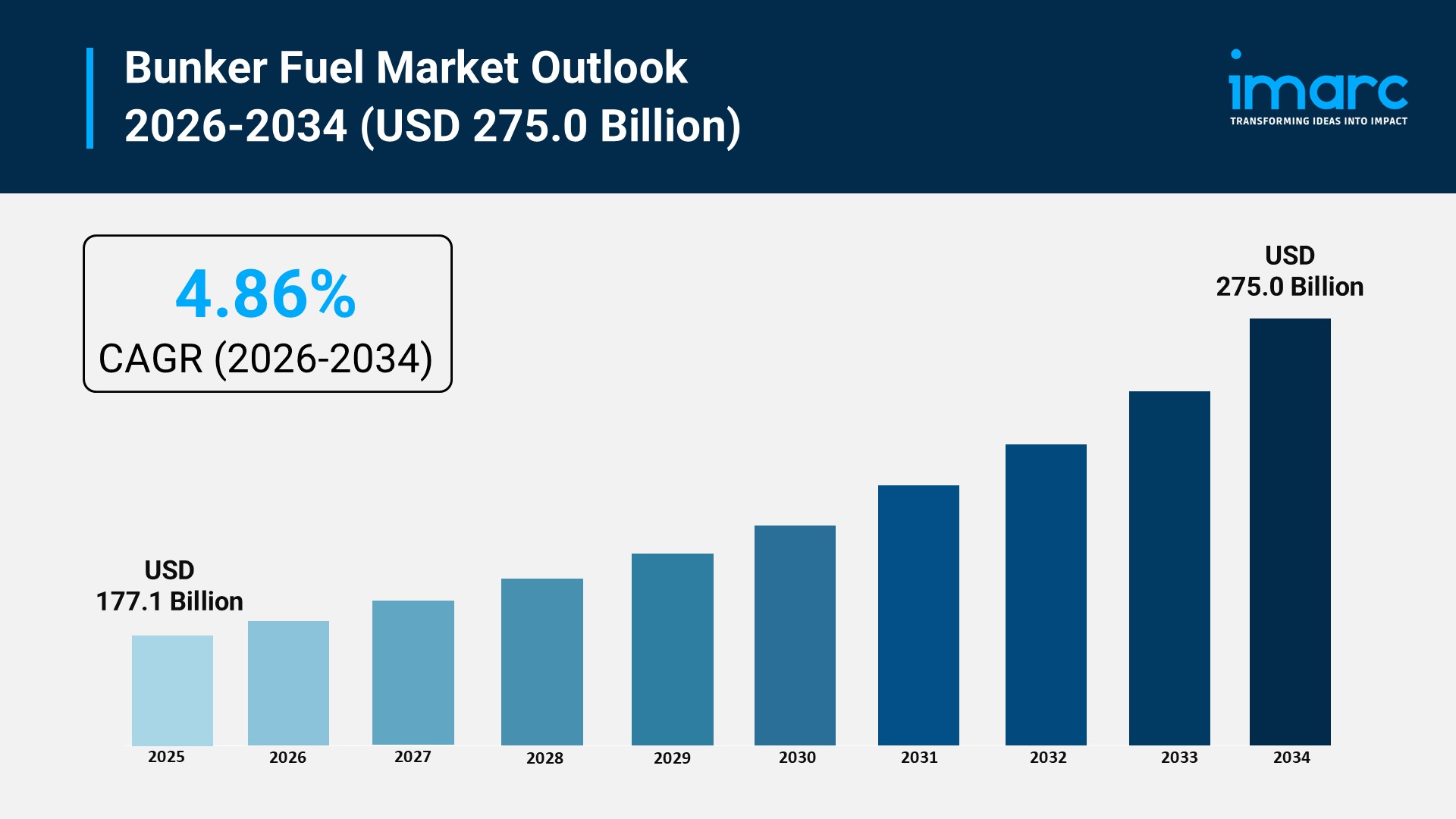
Bunker Fuel Market Size to Hit USD 275.0 Billion by 2034 | With a 4.86% CAGR
Global bunker fuel market driven by maritime trade growth, IMO 2020 compliance, and rising LNG bunkering infrastructure demand.
SHERDIAN, WY, UNITED STATES, May 11, 2026 /EINPresswire.com/ -- The global bunker fuel market was valued at 𝐔𝐒𝐃 𝟏𝟕𝟕.𝟏 𝐁𝐢𝐥𝐥𝐢𝐨𝐧 in 2025 and is projected to reach 𝐔𝐒𝐃 𝟐𝟕𝟓.𝟎 𝐁𝐢𝐥𝐥𝐢𝐨𝐧 by 2034, expanding at a 𝐂𝐀𝐆𝐑 𝐨𝐟 𝟒.𝟖𝟔% during 2026–2034, according to the latest market research report by IMARC Group. Market expansion is driven by rising global maritime trade, tightening IMO environmental regulations accelerating demand for low-sulfur and alternative fuels, Asia-Pacific’s dominant 45.6% regional share, and rapid adoption of Very Low Sulfur Fuel Oil (VLSFO) as the industry-leading fuel type.𝐑𝐞𝐩𝐨𝐫𝐭 𝐇𝐢𝐠𝐡𝐥𝐢𝐠𝐡𝐭𝐬
𝐌𝐚𝐫𝐤𝐞𝐭 𝐒𝐢𝐳𝐞 (𝟐𝟎𝟐𝟓): 𝐔𝐒𝐃 𝟏𝟕𝟕.𝟏 𝐁𝐢𝐥𝐥𝐢𝐨𝐧
𝐅𝐨𝐫𝐞𝐜𝐚𝐬𝐭 (𝟐𝟎𝟑𝟒): 𝐔𝐒𝐃 𝟐𝟕𝟓.𝟎 𝐁𝐢𝐥𝐥𝐢𝐨𝐧
𝐂𝐀𝐆𝐑 (𝟐𝟎𝟐𝟔–𝟐𝟎𝟑𝟒): 𝟒.𝟖𝟔%
𝐋𝐞𝐚𝐝𝐢𝐧𝐠 𝐑𝐞𝐠𝐢𝐨𝐧: 𝐀𝐬𝐢𝐚-𝐏𝐚𝐜𝐢𝐟𝐢𝐜 (𝟒𝟓.𝟔%)
𝐓𝐨𝐩 𝐅𝐮𝐞𝐥 𝐓𝐲𝐩𝐞: 𝐕𝐞𝐫𝐲 𝐋𝐨𝐰 𝐒𝐮𝐥𝐟𝐮𝐫 𝐅𝐮𝐞𝐥 𝐎𝐢𝐥 – 𝐕𝐋𝐒𝐅𝐎 (𝟒𝟑.𝟐%)
𝐓𝐨𝐩 𝐕𝐞𝐬𝐬𝐞𝐥 𝐓𝐲𝐩𝐞: 𝐂𝐨𝐧𝐭𝐚𝐢𝐧𝐞𝐫𝐬 (𝟒𝟎.𝟎%)
𝐋𝐞𝐚𝐝𝐢𝐧𝐠 𝐒𝐞𝐥𝐥𝐞𝐫: 𝐌𝐚𝐣𝐨𝐫 𝐎𝐢𝐥 𝐂𝐨𝐦𝐩𝐚𝐧𝐢𝐞𝐬 (𝟓𝟓.𝟔%)
𝐃𝐨𝐰𝐧𝐥𝐨𝐚𝐝 𝐚 𝐅𝐫𝐞𝐞 𝐒𝐚𝐦𝐩𝐥𝐞 𝐂𝐨𝐩𝐲 𝐨𝐟 𝐭𝐡𝐞 𝐑𝐞𝐩𝐨𝐫𝐭: https://www.imarcgroup.com/bunker-fuel-market/requestsample
𝐁𝐮𝐧𝐤𝐞𝐫 𝐅𝐮𝐞𝐥 𝐌𝐚𝐫𝐤𝐞𝐭 𝐎𝐮𝐭𝐥𝐨𝐨𝐤 𝟐𝟎𝟐𝟔–𝟐𝟎𝟑𝟒
Bunker fuel refers to the petroleum-based marine fuels used to power commercial vessels, including container ships, tankers, and bulk carriers. It remains the backbone of global maritime transport, which underpins the movement of the vast majority of world trade by volume.
The market reached USD 177.1 Billion in 2025 and is projected to reach USD 275.0 Billion by 2034 at a 4.86% CAGR. Growth is shaped by the dual forces of rising seaborne trade volumes and a structural shift in fuel composition driven by the IMO 2020 sulfur cap regulation, which has made VLSFO the dominant marine fuel standard worldwide.
𝐁𝐮𝐧𝐤𝐞𝐫 𝐅𝐮𝐞𝐥 𝐌𝐚𝐫𝐤𝐞𝐭 𝐃𝐫𝐢𝐯𝐞𝐫𝐬 𝟐𝟎𝟐𝟔
● 𝐄𝐱𝐩𝐚𝐧𝐝𝐢𝐧𝐠 𝐆𝐥𝐨𝐛𝐚𝐥 𝐌𝐚𝐫𝐢𝐭𝐢𝐦𝐞 𝐓𝐫𝐚𝐝𝐞
The steady rise in international shipping volumes is one of the primary engines of bunker fuel demand. Increased movement of consumer goods, raw materials, and industrial products via sea routes drives consistent fuel consumption across commercial fleets. Developing economies are expanding their trade footprints, and the diversification of global supply chains is creating new high-traffic shipping corridors, reinforcing the need for reliable marine fuel supply.
● 𝐈𝐌𝐎 𝟐𝟎𝟐𝟎 𝐒𝐮𝐥𝐟𝐮𝐫 𝐂𝐚𝐩 𝐚𝐧𝐝 𝐑𝐞𝐠𝐮𝐥𝐚𝐭𝐨𝐫𝐲 𝐂𝐨𝐦𝐩𝐥𝐢𝐚𝐧𝐜𝐞
Stringent environmental regulations are reshaping the bunker fuel landscape. The International Maritime Organization’s 2020 sulfur cap, which limits sulfur content in marine fuels to 0.5%, has fundamentally redirected demand toward compliant fuels such as VLSFO and Marine Gas Oil (MGO). Ship operators must meet these standards globally, stimulating demand for compliant fuel products and driving supplier investment in refining infrastructure and low-sulfur product portfolios.
● 𝐓𝐞𝐜𝐡𝐧𝐨𝐥𝐨𝐠𝐢𝐜𝐚𝐥 𝐀𝐝𝐯𝐚𝐧𝐜𝐞𝐦𝐞𝐧𝐭𝐬 𝐢𝐧 𝐌𝐚𝐫𝐢𝐭𝐢𝐦𝐞 𝐎𝐩𝐞𝐫𝐚𝐭𝐢𝐨𝐧𝐬
Modern vessels designed for greater fuel efficiency and reduced emissions are reshaping fuel consumption patterns. Advanced engine designs, hull optimization, and digital route planning reduce fuel burn per voyage while expanding operational reach. Innovations such as hybrid electric bunker tankers, LNG-powered vessels, and biofuel compatibility are opening new segments within the broader bunker fuel market.
𝐒𝐩𝐞𝐚𝐤 𝐃𝐢𝐫𝐞𝐜𝐭𝐥𝐲 𝐰𝐢𝐭𝐡 𝐚𝐧 𝐀𝐧𝐚𝐥𝐲𝐬𝐭 𝐟𝐨𝐫 𝐂𝐮𝐬𝐭𝐨𝐦𝐢𝐳𝐞𝐝 𝐈𝐧𝐬𝐢𝐠𝐡𝐭𝐬: https://www.imarcgroup.com/request?type=report&id=2549&flag=C
𝐁𝐮𝐧𝐤𝐞𝐫 𝐅𝐮𝐞𝐥 𝐌𝐚𝐫𝐤𝐞𝐭 𝐓𝐫𝐞𝐧𝐝𝐬 𝟐𝟎𝟐𝟔
𝐒𝐡𝐢𝐟𝐭 𝐭𝐨 𝐋𝐨𝐰-𝐒𝐮𝐥𝐟𝐮𝐫 𝐚𝐧𝐝 𝐀𝐥𝐭𝐞𝐫𝐧𝐚𝐭𝐢𝐯𝐞 𝐅𝐮𝐞𝐥𝐬
The market continues its structural transition away from High Sulfur Fuel Oil (HSFO) and toward VLSFO, LNG, biofuels, and hydrogen-based alternatives. This shift, driven by tightening IMO and regional regulations, is fundamentally reordering supplier priorities and capex allocation across the global bunkering supply chain.
𝐃𝐢𝐠𝐢𝐭𝐚𝐥 𝐁𝐮𝐧𝐤𝐞𝐫𝐢𝐧𝐠 𝐏𝐥𝐚𝐭𝐟𝐨𝐫𝐦𝐬
Digital platforms integrating real-time fuel data, mass flow meter technology, and supply chain transparency are gaining traction. Companies such as Hafnia (FuelSure) and TFG Marine are deploying technology-enabled solutions to improve accountability, reduce procurement costs, and enhance delivery efficiency at major bunkering ports.
𝐁𝐢𝐨𝐟𝐮𝐞𝐥 𝐚𝐧𝐝 𝐒𝐮𝐬𝐭𝐚𝐢𝐧𝐚𝐛𝐥𝐞 𝐌𝐚𝐫𝐢𝐧𝐞 𝐅𝐮𝐞𝐥 𝐀𝐝𝐨𝐩𝐭𝐢𝐨𝐧
Biofuel bunkering operations are accelerating globally, with co-processed VLSFO, hydrotreated vegetable oil (HVO), and blended biofuels now available at key ports including Singapore, Fujairah, Yokohama, and Rotterdam. These fuels offer greenhouse gas reductions of up to 90% versus conventional marine diesel, supporting IMO decarbonization pathways and corporate net-zero shipping targets.
𝐈𝐧𝐟𝐫𝐚𝐬𝐭𝐫𝐮𝐜𝐭𝐮𝐫𝐞 𝐄𝐱𝐩𝐚𝐧𝐬𝐢𝐨𝐧 𝐚𝐭 𝐊𝐞𝐲 𝐁𝐮𝐧𝐤𝐞𝐫𝐢𝐧𝐠 𝐇𝐮𝐛𝐬
Port authorities and maritime operators across Asia-Pacific, the Middle East, and the Americas are investing heavily in bunkering storage capacity, LNG fueling stations, and fleet-compatible delivery systems. These investments are expanding geographic reach and reducing supply bottlenecks at high-traffic maritime corridors.
𝐁𝐮𝐧𝐤𝐞𝐫 𝐅𝐮𝐞𝐥 𝐌𝐚𝐫𝐤𝐞𝐭 𝐒𝐞𝐠𝐦𝐞𝐧𝐭𝐚𝐭𝐢𝐨𝐧
𝐁𝐲 𝐒𝐞𝐥𝐥𝐞𝐫:
● Major Oil Comapnies
● Leading Independent Sellers
● Small Independent Sellers
Major oil companies hold a 55.6% market share in 2025 due to their integrated supply chains and global presence, while leading independent sellers at 28.4% leverage regional expertise and flexible pricing, and small independent sellers at 16.0% cater to niche markets.
𝐁𝐲 𝐅𝐮𝐞𝐥 𝐓𝐲𝐩𝐞:
● VLFSO
● HSFO
● MDO
● LNG
VLSFO dominates with a 43.2% share following IMO 2020 regulations, HSFO accounts for 27.5% supported by scrubber-equipped vessels, MDO stands at 18.6% for smaller vessels, and LNG, at 10.7%, is the fastest-growing segment with a 9.2% CAGR.
𝐑𝐞𝐠𝐢𝐨𝐧𝐚𝐥 𝐈𝐧𝐬𝐢𝐠𝐡𝐭𝐬: 𝐁𝐮𝐧𝐤𝐞𝐫 𝐅𝐮𝐞𝐥 𝐌𝐚𝐫𝐤𝐞𝐭
𝐀𝐬𝐢𝐚-𝐏𝐚𝐜𝐢𝐟𝐢𝐜 – 𝐌𝐚𝐫𝐤𝐞𝐭 𝐋𝐞𝐚𝐝𝐞𝐫 (𝟒𝟓.𝟔% 𝐒𝐡𝐚𝐫𝐞)
Asia-Pacific dominates the global bunker fuel market, anchored by world-class maritime hubs in Singapore, Shanghai, Hong Kong, and Busan. The Strait of Malacca, one of the world’s busiest shipping lanes, generates exceptional fuel demand volumes. Export-driven economies across China, Japan, South Korea, and Southeast Asia sustain high seaborne trade activity, while ongoing port modernization and competitive fuel pricing cement the region’s leading position.
𝐍𝐨𝐫𝐭𝐡 𝐀𝐦𝐞𝐫𝐢𝐜𝐚
North America’s bunker fuel market is anchored by major ports at Houston, Los Angeles, Vancouver, and New York. Strong refining capacity supports compliant fuel supply aligned with IMO 2020 standards. Growing interest in LNG and biofuel infrastructure investments reflects the region’s regulatory commitment to cleaner maritime operations.
𝐄𝐮𝐫𝐨𝐩𝐞
Europe is a key growth market, shaped by EU Emissions Trading System (EU ETS) obligations that cover all large vessels entering EU ports from January 2024. The regulatory framework is accelerating the transition to LNG and biofuels, while major ports across Rotterdam, Antwerp, and Hamburg serve as global bunkering centers.
𝐋𝐚𝐭𝐢𝐧 𝐀𝐦𝐞𝐫𝐢𝐜𝐚
Brazil, Mexico, and Panama are the primary bunkering hubs driving Latin America’s market expansion. Brazil’s USD 3 Billion port infrastructure privatization program is expected to significantly expand regional bunkering capacity and fuel storage capabilities.
𝐌𝐢𝐝𝐝𝐥𝐞 𝐄𝐚𝐬𝐭 𝐚𝐧𝐝 𝐀𝐟𝐫𝐢𝐜𝐚
The region’s strategic position along global trade corridors between Asia, Europe, and the Americas underpins steady fuel demand. Saudi Arabia recorded a 6.4% increase in maritime fleet gross tonnage in 2024, and major UAE ports are emerging as key alternative fuel bunkering hubs aligned with sustainability goals.
𝐕𝐢𝐞𝐰 𝐭𝐡𝐞 𝐅𝐮𝐥𝐥 𝐑𝐞𝐩𝐨𝐫𝐭: https://www.imarcgroup.com/bunker-fuel-market
𝐊𝐞𝐲 𝐂𝐨𝐦𝐩𝐚𝐧𝐢𝐞𝐬 𝐢𝐧 𝐭𝐡𝐞 𝐁𝐮𝐧𝐤𝐞𝐫 𝐅𝐮𝐞𝐥 𝐌𝐚𝐫𝐤𝐞𝐭
Major players profiled in the IMARC Group report include:
● BP p.l.c.
● Chevron Corporation
● Exxon Mobil Corporation
● Neste
● Petroliam Nasional Berhad (PETRONAS)
● TotalEnergies
𝐊𝐞𝐲 𝐓𝐚𝐤𝐞𝐚𝐰𝐚𝐲𝐬 𝐟𝐫𝐨𝐦 𝐭𝐡𝐞 𝐑𝐞𝐩𝐨𝐫𝐭
● Market projected to grow from USD 177.1 Billion (2025) to USD 275.0 Billion by 2034 at a 4.86% CAGR.
● VLSFO leads fuel type segmentation with 43.2% market share, driven by IMO 2020 compliance mandates.
● Container vessels account for 40.0% of total bunker fuel consumption, underpinned by global trade expansion.
● Asia-Pacific dominates with 45.6% share, supported by high-traffic ports and export-driven economies.
● Major oil companies including ExxonMobil, Shell, and BP collectively hold 55.6% of seller market share.
● LNG, biofuels, and co-processed VLSFO are reshaping the fuel mix as decarbonization accelerates.
𝐎𝐭𝐡𝐞𝐫 𝐓𝐫𝐞𝐧𝐝𝐢𝐧𝐠 𝐑𝐞𝐩𝐨𝐫𝐭𝐬 𝐁𝐲 𝐈𝐦𝐚𝐫𝐜 𝐆𝐫𝐨𝐮𝐩:
Dimethyl Ether Market Research Report
Humic Acid Market Research Report
𝐓𝐨𝐨𝐥𝐢𝐧𝐠 𝐁𝐨𝐚𝐫𝐝 𝐌𝐚𝐫𝐤𝐞𝐭: https://www.imarcgroup.com/tooling-board-market
𝐒𝐨𝐝𝐢𝐮𝐦 𝐒𝐢𝐥𝐢𝐜𝐚𝐭𝐞 𝐌𝐚𝐫𝐤𝐞𝐭: https://www.imarcgroup.com/sodium-silicate-market
𝐀𝐫𝐚𝐦𝐢𝐝 𝐅𝐢𝐛𝐞𝐫 𝐌𝐚𝐫𝐤𝐞𝐭: https://www.imarcgroup.com/aramid-fiber-market
𝐀𝐛𝐨𝐮𝐭 𝐈𝐌𝐀𝐑𝐂 𝐆𝐫𝐨𝐮𝐩
IMARC Group is a leading market research company that offers management strategy and market research worldwide. The company partners with clients across all sectors and regions to identify their highest-value opportunities, address their most critical challenges, and transform their businesses. IMARC’s information products cover major market, scientific, economic, and technological developments for business leaders in pharmaceutical, industrial, and high-technology organizations.
𝐂𝐨𝐧𝐭𝐚𝐜𝐭 𝐔𝐬
IMARC Group
134 N 4th St., Brooklyn, NY 11249, USA
Email: sales@imarcgroup.com
Tel: +1-631-791-1145
Website: www.imarcgroup.com
Elena Anderson
IMARC Services Private Limited
+1 201-971-6302
email us here
Legal Disclaimer:
EIN Presswire provides this news content "as is" without warranty of any kind. We do not accept any responsibility or liability for the accuracy, content, images, videos, licenses, completeness, legality, or reliability of the information contained in this article. If you have any complaints or copyright issues related to this article, kindly contact the author above.
