

Hydrogen Electrolyzer Market
Behind the electrolyzer boom, a new competitive map is emerging shaped by technology economics, project pipelines and regional industrial demand.
Wilmington, DE, United States, Sept. 07, 2026 (GLOBE NEWSWIRE) -- Hydrogen Electrolyzer Capacity is Being Quietly Locked up while Most Buyers Still Treat it as a Future Procurement Decision
The Hydrogen Electrolyzer Market has crossed the threshold from policy aspiration to industrial reality. What strategy teams once modeled as a 2030s opportunity is now a present-tense allocation problem, with manufacturing slots, qualified engineering capacity, and offtake commitments being claimed faster than most boardrooms have recalibrated to recognize. The pace has outrun the planning cycles of organizations still treating this as a future agenda item.
Beneath the surface of headline project announcements, a quieter restructuring is underway. Anchor industrial buyers in steel, ammonia, and refining are signing framework contracts that lock supply chains for the better part of a decade. The directional conclusion is straightforward. The companies negotiating today are negotiating against rivals who already secured their position eighteen months ago, and that gap is widening each quarter.
Request a Free Sample Report: https://marketmindsadvisory.com/request-sample/?report_id=53
Key Takeaways from Hydrogen Electrolyzer Market
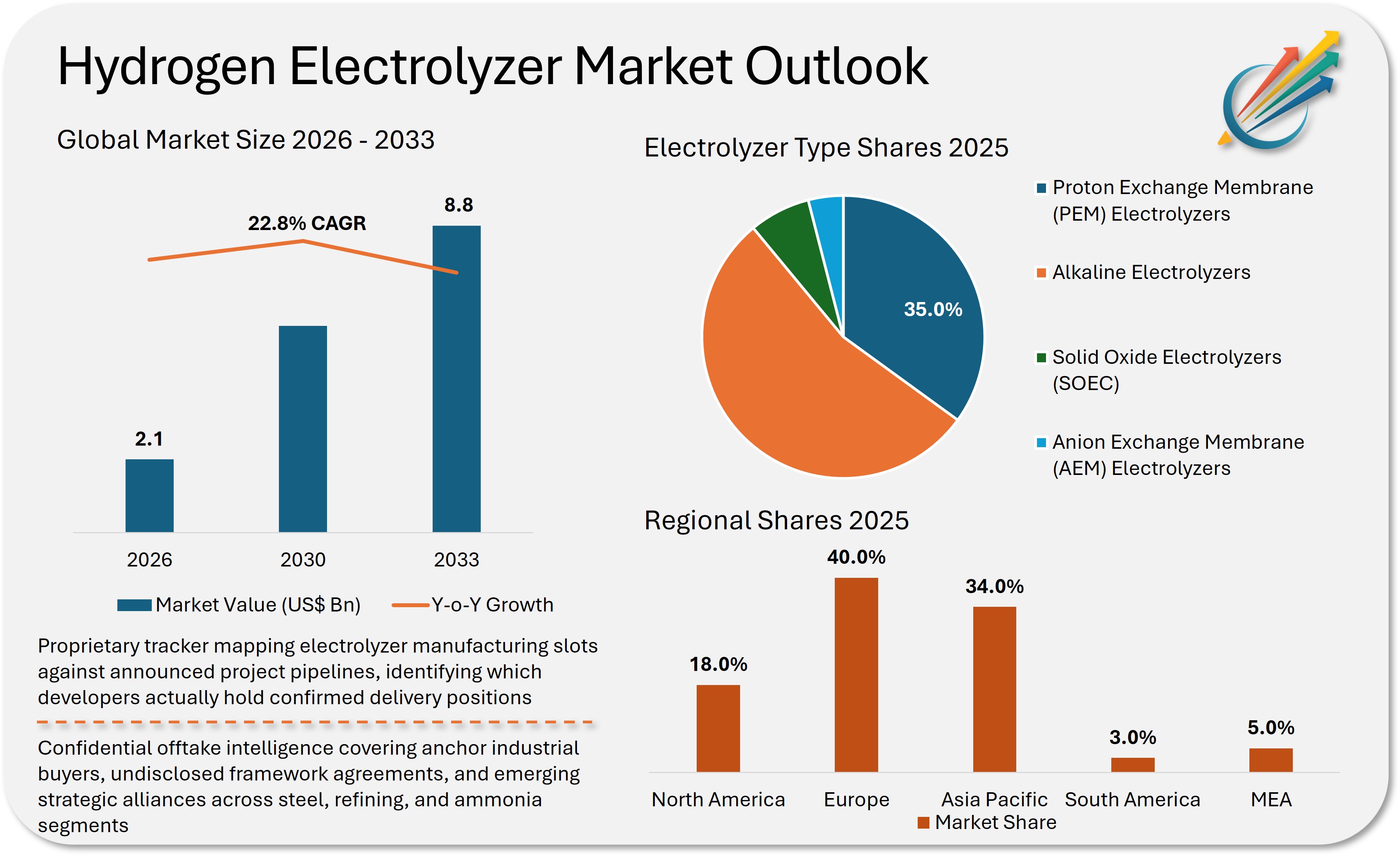
- The global hydrogen electrolyzer market is projected to reach US$ 2.1 billion in 2026, expanding to US$ 8.8 billion by 2033
- The market is forecast to register a CAGR of 22.8% between 2026 and 2033, one of the steepest expansion trajectories in the industrial equipment category
- Alkaline electrolyzers retain dominance in installed base, but PEM systems are capturing a disproportionate share of new utility-scale orders due to dynamic load-following capability
- Manufacturing capacity reservations now extend 18 to 30 months ahead of delivery for tier-one OEMs, effectively rationing access for late entrants
- Steel, ammonia, and refining offtakers account for the majority of contracted gigawatts, with mobility applications trailing earlier expectations
- Solid oxide and AEM technologies remain commercially smaller but are attracting concentrated strategic capital, particularly from buyers seeking efficiency or capex differentiation
- Project finance economics are increasingly determined by the credibility of the OEM's delivery schedule rather than headline LCOH assumptions
According to Research Manager from Market Minds Advisory, "The market has shifted from a question of if electrolyzers scale to a question of who secures capacity first. Organizations that lock manufacturing slots and offtake relationships within the next four to six quarters will set the cost economics that competitors must subsequently match."
Strategic Window Why the Next Two Quarters Are Decisive for Long-Term Positioning
The market is moving through a narrow phase where pricing, supplier relationships, and qualified workforce access are still negotiable. Companies that delay risk inheriting terms set by earlier movers.
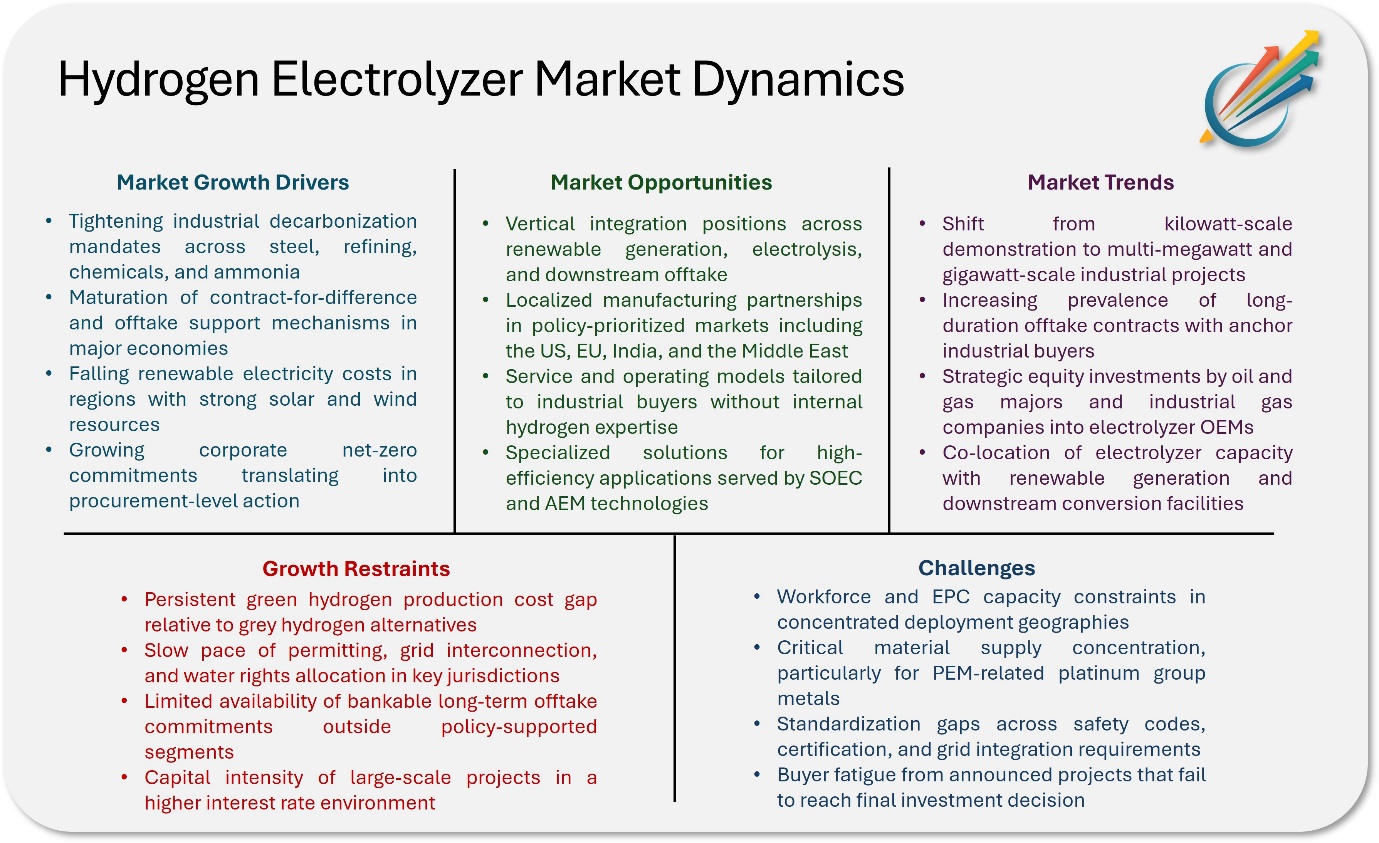
- Manufacturing Slot Scarcity: Tier-one electrolyzer producers are quoting delivery windows extending well into the late decade. Capacity reservations now function as strategic assets rather than procurement line items.
- Offtake Velocity: Anchor buyers in steel, fertilizer, and refining are converting memoranda into binding contracts. The remaining unallocated demand-side opportunities are concentrated and shrinking.
-
Subsidy Sequencing: European and North American support mechanisms are tightening qualification criteria. Projects without established supplier relationships face longer approval cycles and weaker economics.
Critical Market Inflection as Capacity Reservations Now Precede Final Investment Decisions
Project economics have inverted from earlier cycles. Securing manufacturing capacity has become a precondition for raising project finance, not a downstream procurement task.
- Supply Chain Vertical Integration: Leading developers are buying upstream into stack and component manufacturing. The companies controlling iridium, membranes, and balance-of-plant inputs are capturing margin previously distributed across the chain.
- Scale Economics Bifurcation: Sub-10 MW deployments and gigawatt-scale facilities now operate under fundamentally different cost curves. Mid-range projects face the steepest commercial pressure.
-
Bankability Gates: Lenders are pricing technology track record, vendor balance sheets, and warranty terms more aggressively. Newer entrants without operational reference plants are encountering financing premiums that erode their cost advantage.
Shape this report around your question: https://marketmindsadvisory.com/request-customization/?report_id=53
Strategic Market Realities That Diverge From Consensus Expectations
A substantial share of announced gigawatt pipelines will not reach commercial operation by 2030. Public project announcements exceed realistic manufacturing throughput, qualified workforce availability, and financing capacity. The more important question is identifying which projects will actually be built, not aggregating headline numbers.
Alkaline technology will retain meaningful market share well beyond consensus forecasts. PEM dominance narratives understate alkaline's cost position in steady-state industrial applications. The two technologies are diverging into separate use-case domains rather than competing head-to-head.
The most attractive value pool may not be in electrolyzer manufacturing at all. Stack components, balance-of-plant systems, and integrated project development services offer more defensible economics than commoditizing electrolyzer hardware itself, particularly as Asian manufacturers scale aggressively.
Structural Drivers Reshaping Competitive Boundaries Across the Value Chain
Renewable Integration Economics
Electrolyzers are becoming embedded infrastructure within renewable project economics. Solar and wind developers are integrating hydrogen production to monetize curtailed energy and stabilize project returns. This creates a direct mechanical linkage between renewable build-out and electrolyzer deployment, and the companies sitting at this intersection are capturing value neither pure renewable nor pure hydrogen developers can access independently.
Industrial Decarbonization Mandates
Steel, ammonia, and refining sectors face binding emission targets within commercial planning horizons. These industries are anchor buyers with the volume and credit profile to underwrite gigawatt-scale projects. The structural shift is that electrolyzer demand is no longer speculative. It is being driven by industrial customers with regulatory deadlines and balance sheets capable of long-tenor offtake commitments.
Geographic Cost Arbitrage
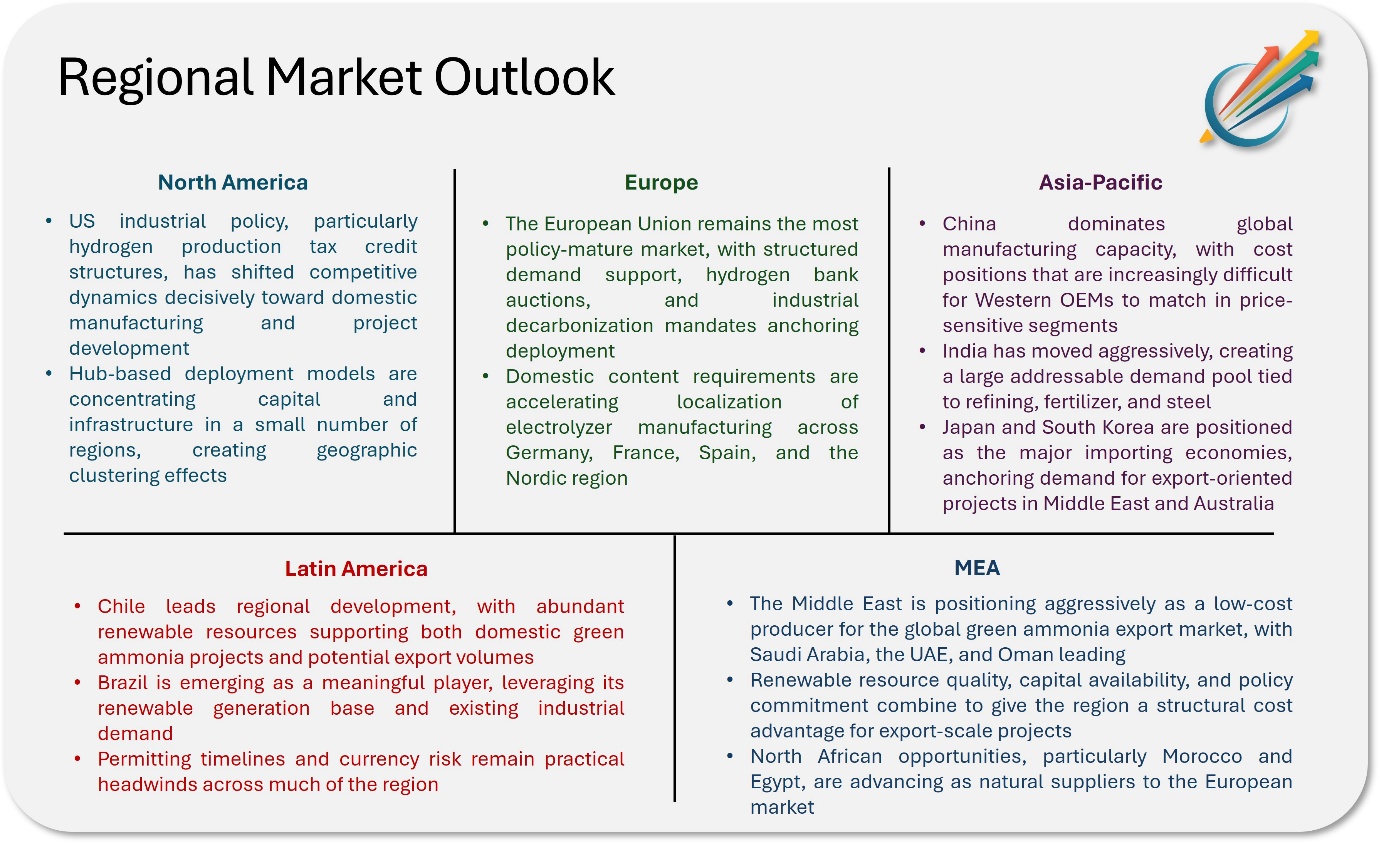
Resource-rich regions in the Middle East, Australia, North Africa, and parts of Latin America are positioning as export hubs supplying demand-heavy regions in Europe and East Asia. This is producing a new layer of cross-border infrastructure including ammonia carriers, methanol value chains, and dedicated shipping. Electrolyzer specification is increasingly being driven by export-corridor logic rather than purely domestic considerations.
Manufacturing Localization Pressure
Industrial policy in the United States, the European Union, India, and elsewhere is conditioning subsidy access on local content. This is reshaping where capacity gets built and which players win contracts. Multinational manufacturers are restructuring their footprints, and regional champions are emerging in markets that previously imported most equipment.
Risk Assessment Material Headwinds That Could Moderate Deployment Pace
- Renewable power availability and pricing volatility: Green hydrogen economics depend on access to low-cost renewable electricity at scale. Grid congestion, curtailment management, and PPA pricing inflation can compress project economics and delay FIDs.
- Offtake price formation challenges: A persistent gap between buyer willingness to pay and producer cost of supply remains the largest open question. Bridging mechanisms, including contract-for-difference structures, are still maturing.
- Workforce and engineering capacity constraints: EPC firms with hydrogen project experience are limited in number, and qualified construction labor is becoming a scheduling bottleneck in concentrated regional markets.
- Permitting and water access friction: Electrolyzer projects require water sourcing, environmental clearance, and grid interconnection approvals that vary widely in duration and predictability across jurisdictions.
- Technology selection risk for early adopters: Buyers committing to specific technology platforms now bear the risk of efficiency improvements or cost reductions in alternative platforms over the next five years.
- Geopolitical exposure in supply chains: Critical materials, including iridium, platinum group metals, and certain rare earths, have concentrated supply geographies that introduce price and availability risk.
Market Dynamics Shaping the Hydrogen Electrolyzer Market
Hydrogen Electrolyser Market Segmentation
By Electrolyzer Type
- Proton Exchange Membrane (PEM) Electrolyzers
- Alkaline Electrolyzers
- Solid Oxide Electrolyzers (SOEC)
- Anion Exchange Membrane (AEM) Electrolyzers
Alkaline retains the largest installed base and remains the workhorse for steady-state industrial applications, particularly where capex sensitivity is high. PEM is capturing a disproportionate share of new utility-scale and renewable-coupled deployments due to its dynamic load-following profile. SOEC is attracting concentrated strategic interest for high-temperature industrial integration, while AEM remains earlier in commercialization but is positioned as a potential lower-cost alternative if scale economics materialize.
By Power Rating
- Micro Scale (< 100 kW)
- Small Scale (100 kW–1 MW)
- Medium Scale (1 MW–10 MW)
- Large Scale (Above 10 MW)
The center of gravity has decisively shifted toward large-scale deployments, where industrial offtakers and project developers concentrate their economics. Medium-scale systems retain relevance for distributed industrial applications and early-stage refueling infrastructure. Small and micro-scale segments serve niche applications including backup power, off-grid use, and research, with steady but structurally smaller demand profiles.
By Ownership Model
- Owner-Operated
- Vendor Operated / Managed Service
- Power Producer / Electrolyzer Operator (IPP Model)
- Lease / Rental Model
- Public-Private Partnership (PPP) Projects
Owner-operated remains common among industrial buyers integrating hydrogen into existing process operations, particularly in chemicals and refining. The IPP model is gaining traction in markets with structured offtake support, allowing developers to bear capex risk in exchange for long-term contracted revenue. Vendor-operated arrangements appeal to buyers without internal operational expertise, while PPP structures are emerging in publicly anchored projects across the EU, Middle East, and parts of Asia.
By Application
- Power-to-Hydrogen
- Power-to-X (Ammonia, Methanol, E-Fuels)
- Green Hydrogen Production
- Industrial Process Heat
- Backup Power and Off-Grid Power
- Desalination
- Others
Green hydrogen production for industrial offtake represents the dominant near-term application, with Power-to-X (particularly green ammonia) emerging as the primary export-oriented use case. Industrial process heat is an underdiscussed segment with meaningful long-term potential as high-temperature electrolysis matures. Backup power, off-grid, and desalination applications remain smaller in volume but offer differentiated margin profiles for specialized providers.
By End Use Industry
- Oil & Gas
- Chemicals & Petrochemicals
- Steel & Metallurgy
- Transportation & Mobility
- Energy & Utilities
- Heavy Industry & Manufacturing
- Data Centers
- Commercial & Industrial Buildings (Onsite)
- Others
Steel, refining, and chemicals dominate contracted demand, reflecting the regulatory pressure and the technical fit of hydrogen as a feedstock or reductant. Energy and utilities sit at the intersection of producer and offtaker roles, often anchoring large IPP-style projects. Mobility demand is materializing more slowly than early forecasts suggested, while data centers represent a small but strategically interesting emerging segment for hydrogen-based backup and onsite generation.
Regional Market Outlook
Investment Focus Where the Most Defensible Value is Concentrating
Stack and Component Manufacturing
The bottleneck is shifting from electrolyzer assembly to stack and component supply. Membranes, electrodes, bipolar plates, and balance-of-plant systems are where margins are most defensible. Companies controlling these inputs, particularly those with established quality records, are capturing structurally advantaged positions as gigawatt projects ramp.
Integrated Project Development
The combination of renewable generation, electrolyzer capacity, and offtake aggregation is producing a new asset class. Developers who can sequence land, power, equipment, and offtake into bankable packages are commanding premium economics. This integration capability is scarce and difficult to replicate.
Industrial Offtake Aggregation
Anchor buyers in steel, ammonia, and refining represent concentrated demand that financiers will underwrite. Companies that can structure long-tenor offtake contracts with creditworthy industrial users are removing the largest risk from project finance. This is increasingly where competitive positioning is decided.
Storage and Transport Infrastructure
Produced hydrogen needs to move and store economically. Investments in salt cavern storage, ammonia carriers, dedicated pipelines, and regional distribution networks are emerging as the next infrastructure layer. Early positions here will define the connectivity of the broader hydrogen economy for decades.
What This Means for Decision-Makers
Energy companies - The hydrogen electrolyzer market has moved past the phase where wait-and-see is a defensible strategy. Securing manufacturing slots, anchor offtake positions, and integrated value chain capabilities in the next four to six quarters will define competitive cost positions for the next decade. Treating electrolyzer access as a strategic asset rather than a procurement step is the posture that distinguishes leaders from followers.
Industrial manufacturers - Steel, chemicals, refining, and ammonia producers face a closing window to lock in supply on favorable terms. Long-duration offtake contracts signed now establish reference economics that are difficult to replicate later. Internal capability to evaluate technology choices, structure complex contracts, and manage hydrogen integration is becoming as valuable as the supply itself.
Investors - The investment thesis has matured past pure technology speculation. Manufacturing capacity, integrated project development, and anchor offtake-backed projects now offer clearer risk-return profiles than headline pipeline announcements. Capital deployed into proven execution capability and supply chain depth is structurally advantaged over capital chasing speculative gigawatt totals.
Project developers - The differentiator is no longer the size of the announced pipeline but the credibility of delivery. Confirmed OEM allocation, contracted offtake, and secured grid and permitting positions are the assets that attract serious capital. Developers without these credentials will find both financing and supply increasingly difficult to access on competitive terms.
Competitive Landscape – Hydrogen Electrolyzer Market
Recent Market Developments
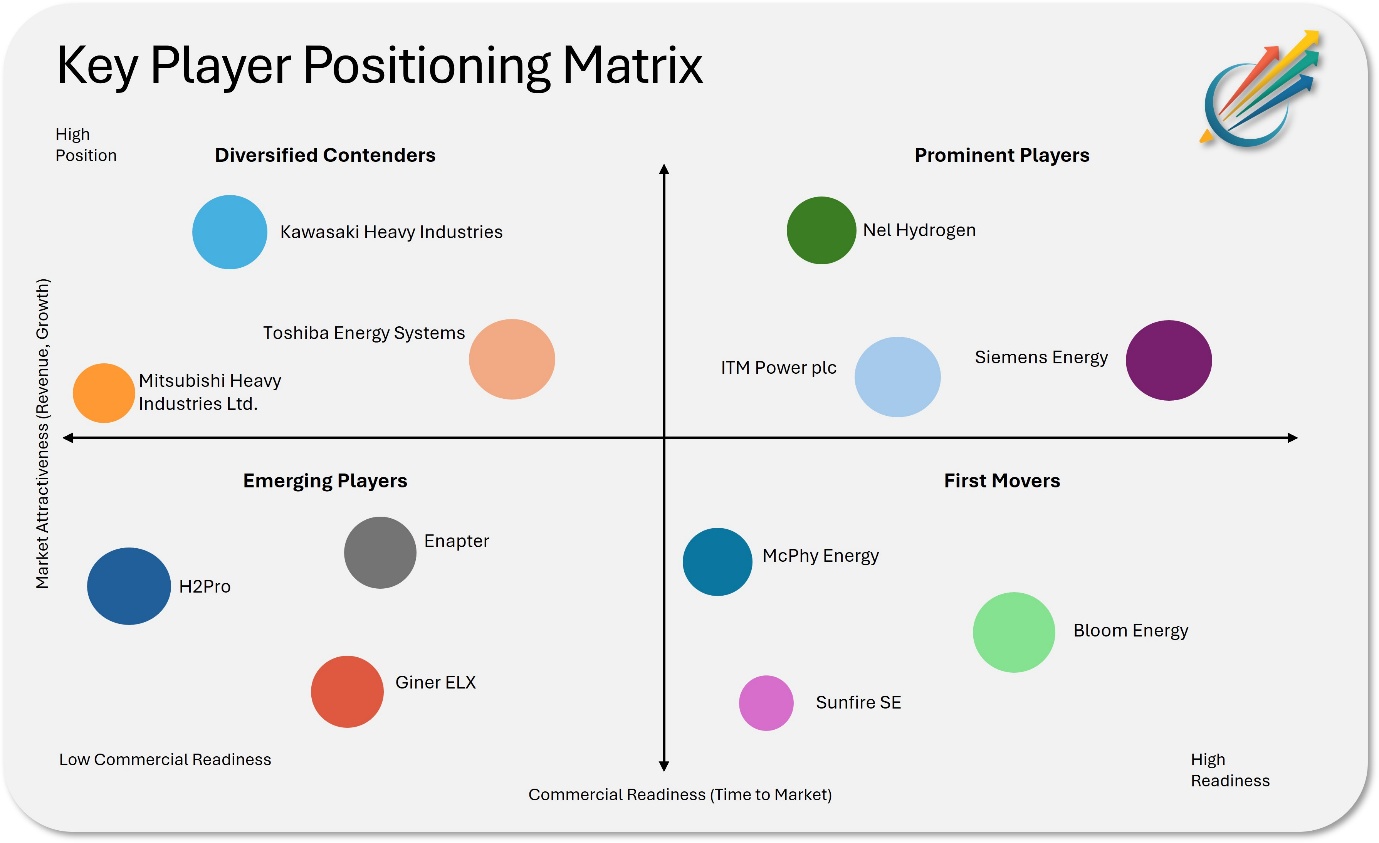
- In April 2026, Thyssenkrupp Uhde Chlorine Engineers announced expansion of its alkaline electrolyzer module production capacity to address sustained order book growth from utility-scale industrial customers
- In February 2026, Nel Hydrogen advanced commissioning of its expanded automated PEM electrolyzer manufacturing line to support deliveries against multi-year customer commitments
- In January 2026, Plug Power Inc. progressed operational milestones at its US-based green hydrogen production facilities, reinforcing its integrated production and supply position
- In December 2025, Siemens Energy strengthened its electrolyzer joint venture activities, reflecting the broader trend of OEMs deepening partnerships with industrial gas and energy companies
Buy Now: https://marketmindsadvisory.com/buy-now/?report_id=53
Trending Related Reports
- Aircraft Electric Motor Market: Everyone is watching aircraft batteries. The more consequential question may be what happens inside the motor as aviation pushes toward higher power density and efficiency.
- Green Ammonia Market: Billions are being committed to green ammonia, but only a fraction of announced capacity is reaching investment decisions. Here’s what separates viable projects from hype.
- Air Filters Market: The air-filter market is splitting in two: commodity filtration faces cost pressure while high-efficiency, low-energy and contamination-control solutions capture increasing value.
- Advanced Server Energy Monitoring Tools Market: The real energy problem in modern data centers isn't consumption alone, it’s the inability to see where power, capacity and efficiency are being lost.
- Advanced Energy Storage System Market: Battery costs are falling, but the real opportunity is shifting upstream toward grid flexibility, new revenue streams and long-duration storage.
- Benelux Power Tools Market: The biggest shift in Benelux power tools isn't cordless adoption, it’s the rise of battery ecosystems that can lock contractors into years of future purchases.
- Heavy Duty Pump Market: A pump failure can cost far more than the equipment itself. The market is shifting toward smarter systems designed around uptime, efficiency and total operating economics.
- Digital Pump Controller Market: A pump failure can cost far more than the equipment itself. The market is shifting toward smarter systems designed around uptime, efficiency and total operating economics.
- Microturbines Market: The microturbine opportunity is shifting from backup power to strategic energy infrastructure where grid constraints, resilience and distributed generation are rewriting the economics.
- Industrial Power Monitoring System Market: Most factories measure how much power they consume. The leaders are learning where, when and why they lose it and turning that intelligence into an operational edge.
Why choose Market Minds Advisory
Market Minds Advisory delivers decision-grade intelligence to executives across machinery, packaging, chemicals, automotive, ICT, food and beverage, consumer goods, and healthcare. We help organizations sharpen market expansion strategies, accelerate share gains, refine brand positioning, and enable account-level growth. Our forecasting integrates primary interviews, proprietary demand models, and continuous market validation, producing the kind of clarity volatile and emerging industries require. Backed by over a decade of sector expertise, our research surfaces white space, opportunity gaps, and competitive blind spots, accounting for recent developments and geopolitical risk. We help businesses see the future of their markets.
Market is segmented by Electrolyzer Type (PEM, Alkaline, SOEC, AEM), Power Rating (Micro, Small, Medium, Large Scale), Ownership Model (Owner-Operated, Vendor Operated, IPP, Lease, PPP), and Application (Power-to-Hydrogen, Power-to-X, Green Hydrogen Production, Industrial Process Heat, Backup Power, Desalination)
Contact Us:
1521 Concord Pike, Suite 301
Wilmington, DE 19803 USA
T: +91 93563 13602
Email: sales@marketmindsadvisory.com
Website: https://marketmindsadvisory.com/


Legal Disclaimer:
EIN Presswire provides this news content "as is" without warranty of any kind. We do not accept any responsibility or liability for the accuracy, content, images, videos, licenses, completeness, legality, or reliability of the information contained in this article. If you have any complaints or copyright issues related to this article, kindly contact the author above.
